
Queenslanders’ right to object to mining projects – including coal – would be “gutted” by new legislation that would ban opponents from being heard in court without the minister’s approval and then only if they owned a property within a 125km radius of the project.
The Greens have called the move “corrupt” and community action group Lock the Gate Alliance said the state’s LNP government was “tearing up democratic and environmental protections just to make life easier for mining companies”.
The state’s minister for natural resources, Dale Last, who tabled the legislation on Tuesday, said the bill was “about streamlining approvals and making faster decisions”.
“Activists based thousands of kilometres away and green groups funded by foreign overseas entities are no longer eligible to have a say,” he said.
“Objections received from a person or group outside the 125km boundary whose interests would not be affected will no longer be accepted.”
Queensland produces most of Australia’s coal and has the country’s second-largest mining industry, behind Western Australia. It is the most polluting state, due to its use of coal for energy.
Under current law an objection to a mining project is automatically referred to the state’s land court for independent consideration.
The legislation will amend that by giving the decision-maker the discretion whether or not to refer it on to the court.
In the case of mining leases, the decision-maker is the resources minister. For environmental approvals, it is the director general of the environment department.
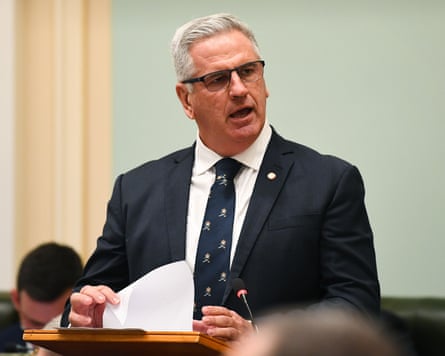
Anthony Gough, acting director of Queensland Conservation Council, said that would mean the minister of the day could “pick and choose which community objections get heard in open court, and which mines get waved through without that scrutiny”.
He said the bill “strips community members of their right to have their objection to damaging mining projects heard in court”.
“The vast majority of objections are made by local groups and landholders to protect agricultural land as well as local bushland, native habitat or water resources. It was this process that led to the cessation of sand mining on World Heritage-listed K’gari [Fraser Island].
“Queenslanders should be able to protect every inch of the state from inappropriate and invasive mining. They shouldn’t be denied that right simply because they live more than 125km away from a particular mine.”
The government last year cancelled a months-long review of the laws dealing with objections to mining leases by the independent Queensland Law Reform Commission, weeks before it would have released its findings.
It replaced the review with one conducted by a cabinet subcommittee.
Last told parliament objections were “one of the biggest hindrances on project timelines and delays” and the government was “laser focused on improving approval timeframes”.
“You only need to look at the debacle of the long-running legal battle that the New Acland coalmine expansion experienced to understand that this process has to change,” he said.
The legal battle against the mine lasted 11 years, and went all the way to the high court.
A spokesperson for the Oakey Coal Action Alliance, a group of local farmers which litigated the case for 11 years, said the group had won its right to be heard at the high court.
“As is evident now, King Coal also heard and had the Queensland Government change the laws so we could not win again,” the spokesperson said.
“What the laws are designed to do is to stop anyone who understands we are in a climate crisis from objecting to putting more CO2 in the atmosphere.”
Lock the Gate Alliance national coordinator, Ellen Roberts, said the government was “tearing up democratic and environmental protections just to make life easier for mining companies – it is following Campbell Newman’s playbook to the letter”.
Queensland’s LNP government dramatically expanded objection rights against planning approvals for windfarms last year, and recently passed legislation permitting the government to compulsorily acquire land for coal mining.


